MADE IN THE USA AND GUARANTEED FOR LIFE


The Ultimate Guide to Work Hoodies: Fabric, Weight, and Fit (2026)

by Dan McCarthy September 14, 2026 11 min read

The Ultimate Guide to Work Hoodies: Fabric, Weight, and Fit (2026)

A work hoodie differs from a regular one in three measurable ways: fabric weight — 10 ounces and up, against roughly 8 for a typical retail fleece; fiber content that abrades rather than melts, which means cotton or a cotton blend rather than 100% polyester; and reinforcement at the elbows and forearms, which is where a hoodie actually fails first. Everything else is styling.

Almost every hoodie sold as workwear is sold on a picture and a price. The information that would tell you whether it survives a winter — fabric weight, fiber content, where the reinforcement sits — is either buried in a spec tab or not published at all.

This is the guide to reading those specs. It covers what the fabrics actually do, what the weight number means and doesn't mean, how a hoodie fails on a jobsite, and how to match one to the work you do. It names products and materials throughout, including the ones we don't make.

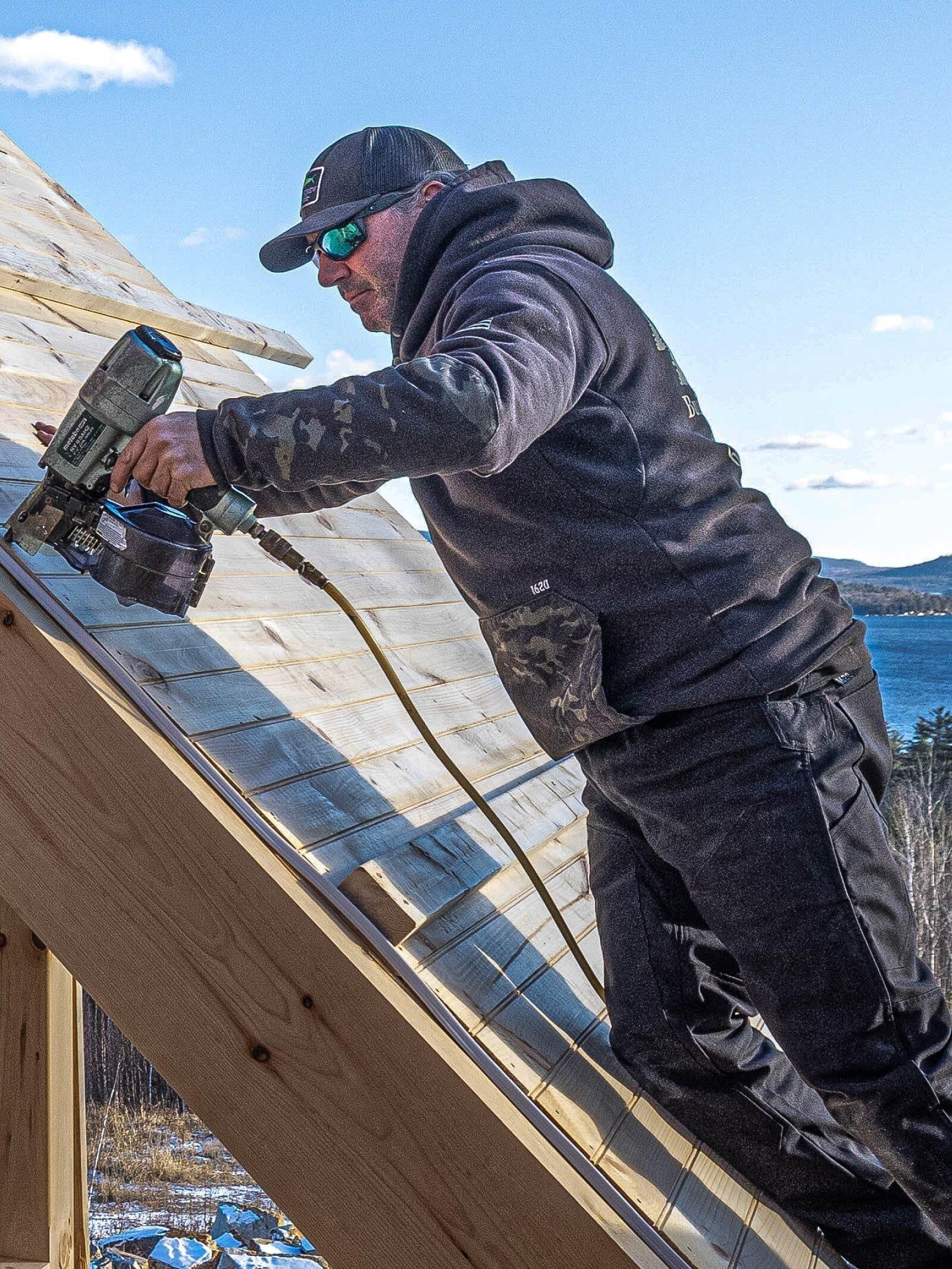
A worn heavyweight fleece work hoodie on a jobsite, showing pilling and wear at the forearm

1. Fabric: what a work hoodie is actually made of

Fleece is a construction, not a fiber. The same word covers a 100% cotton loopback and a 100% polyester microfleece, and they behave nothing alike on a jobsite. Four fabrics account for nearly everything in the category:

  • 100% cotton fleece. Warm, breathable, and comfortable against skin. It also absorbs sweat and holds it — a soaked cotton hoodie stays cold and heavy for the rest of the shift. It shrinks on the first hot wash, and it pills where it rubs.
  • Cotton/polyester blend fleece. The workwear standard, usually 50/50 or 80/20. Polyester adds shrink resistance, faster drying and some structure; cotton keeps the hand and the breathability. Most mass-market work hoodies sit here, at around 10 to 11 ounces — it is the center of gravity for the category and the thing everything else gets measured against.
  • 100% polyester fleece. Lightest, warmest per ounce, dries fastest. It is also the one fabric in this list that melts, which rules it out of several trades entirely. More on that below.
  • Cotton-nylon (NYCO) and nylon-faced reinforcement. Nylon carries abrasion resistance that cotton doesn't. It rarely shows up as a whole hoodie — it shows up as panels at the elbow and forearm, which is where the abrasion is. NYCO has been bought by the U.S. military for more than 40 years, which is a large part of why a domestic supply chain for it exists at all (Cordura).

The melt problem, stated plainly

Polyester is a thermoplastic. Near a flash fire, an electric arc or hot slag it doesn't char — it softens, melts and sticks. Cotton, by contrast, burns and chars without adhering to skin.

That distinction is written into workplace rules. OSHA's standard for electric power generation, transmission and distribution work prohibits clothing that could melt when exposed to flames or electric arcs.

Three standards, and they do not mean the same thing

This is where most workwear writing goes wrong, including writing by companies that should know better. There are two separate properties and three separate standards:

  • NFPA 1975 — thermal stability. The standard for station and work uniforms worn at the station or under turnout gear. It tests that a garment will not melt, drip or ignite under defined heat exposure. It requires thermal stability, not flame resistance — the revised edition dropped flame-resistance testing altogether. Cotton, wool and certain blends can pass it; polyester generally can't.
  • NFPA 2112 — flame resistance, flash fire. A different property and a much higher bar.
  • ASTM F1506 — flame resistance, electric arc. Same again, for arc flash exposure.

So: a garment can be certified not to melt on you and still burn. Those are different problems with different standards, and a product page that says "no melt, no drip" is telling you about the first one only.

What that means practically, and it applies to us as much as anyone:

  • A 100% cotton hoodie will still burn. It burns and chars instead of fusing to skin. That is better. It is not protection.
  • Most work hoodies contain polyester — including the 50/50 blends that dominate the category — and polyester is the fiber that fails the thermal-stability test.
  • Some work hoodies are specified to NFPA 1975. Ours were on the Multicam Full Tech run, which carried inherent no-melt, no-drip thermal properties.
  • None of that is flame resistance. If you weld, cut hot or work energized, you need a garment certified to NFPA 2112 or ASTM F1506. Ours are not, and nothing in this guide changes that.

For every other trade — carpentry, framing, paving, stone, HVAC, general construction — the melt question is about sparks and grinder work, and the practical answer is to keep polyester-dominant fleece away from them.

2. Weight: the number that gets printed, and what it doesn't tell you

Fabric weight is measured in ounces per square yard, on the fabric, before the garment is cut. It is the single most useful published spec and the most commonly misread. Rough bands:

  • 8–9 oz — lightweight. Most retail fleece. A layer, not a jacket.
  • 10–11 oz — midweight. The workwear default, and where most of the shelf sits.
  • 12–14 oz — heavyweight. What people mean by a "real" work hoodie. Warm enough to be an outer layer in shoulder season.
  • 14 oz and up — outerwear territory. Often too warm to work in once you're moving.

Three things the number does not tell you:

  1. Weight is not durability. A 14-ounce short-staple cotton fleece with a loose knit will pill and thin faster than an 11-ounce blend with a tight one. Weight measures mass, not construction.
  2. Weight is not warmth. Loft traps air; mass doesn't. A lofted 10-ounce fleece can out-insulate a dense 13-ounce one.
  3. Weight changes after the first wash. A cotton-heavy fleece can shrink several percent, which raises the measured weight per square yard while making the garment smaller. A hoodie that "got heavier" mostly got shorter.

What to do with the number, practically: use it to rule things out rather than to pick a winner. Under 10 ounces is a layering piece. Over 12 is a cold-weather garment you will take off by ten in the morning in April.

3. Fit: how a hoodie actually fails on a jobsite

A hoodie that fits standing still in a fitting room can be unwearable on a ladder. The failures are predictable and they are all about movement:

  • Sleeves ride up when you reach overhead. The most common complaint in the category, and it is a pattern problem, not a size problem. Sizing up to fix it gives you a garment that's too big everywhere else. Look for a longer sleeve spec or a raglan shoulder before you look at a bigger size.
  • The hem untucks when you bend. Standard retail body length assumes you are standing upright. A longer body is the single most noticeable difference between a hoodie cut for work and one cut for a shelf.
  • The hood doesn't work with a hard hat. Most hoods fit neither under nor over one. A helmet-compatible hood is an actual pattern spec — extra volume and a cut that clears the brim — and it is worth checking for by name if you wear a hat all day.
  • It won't layer. The hoodie has to fit over a tee and under a jacket without binding at the shoulder. A close-fitting hoodie becomes a base layer you can't wear anything over.
  • The kangaroo pocket catches. On ladders, in tight framing, around rotating equipment. Some trades cut them off. If you're one of them, buy accordingly rather than assuming you'll get used to it.

Our own Basic Work Hoodie is cut long with a helmet-compatible hood for exactly these reasons. That's a design choice, not a claim of superiority — several makers do the same thing, and it is worth checking whichever one you're looking at.

4. Construction: the parts that fail first

Fabric gets the attention. Hardware and seams are what end the garment. In rough order of how often they go:

  • Cuffs and waistband. Rib knit with spandex in it dies first — the elastic breaks down, the cuff goes slack, and the sleeve starts riding up even if the pattern was right. Low-profile or reinforced cuffs last longer.
  • Elbows and forearms. The highest-abrasion zone on any upper body garment for anyone who carries material or leans on things. This is where nylon panels earn their keep. Our Full Tech Work Hoodie puts CORDURA at the elbows, forearms and pocket for this reason.
  • Shoulders and upper back. Tool bags, vests and harnesses wear the fabric from the outside. Nothing fixes this except heavier fabric and a tighter knit.
  • Zippers and snaps. A coil zipper on a heavy garment is a false economy. Named hardware — YKK, for instance — is one of the few quality signals on a product page that means something specific.
  • Hood drawstrings. Not a durability item, a safety one. A drawstring is a loose cord near rotating equipment, and several trades cut them out on day one. Some work hoodies replace them with snaps for exactly that reason — ours do. Worth checking before you buy rather than after you've cut them.
  • Pilling. Comes from short-staple cotton and low-twist yarn rubbing against itself. It's cosmetic at first and structural eventually, because the fibers leaving the surface are fibers no longer in the fabric.

Reviewing the hoodie for Gear Patrol, Tanner Bowden described the fabric as an "abrasion-resistant, melt-resistant, water-repellent cotton blend fleece" and noted the reinforcement at the elbows, forearms and front pocket as buyable options rather than fixed features. Third-party observation of what a garment does is worth more than anything the company that made it says about it, which is why we cite it here rather than paraphrasing ourselves.

Laid out on the garment, the failure points and the answers to them look like this:


Every callout on this diagram maps to a failure point in the list above: reinforcement at the pocket, elbows and cuffs; gusseting where the shoulder binds; snaps instead of a drawstring; a hood cut to clear a helmet. This is the limited-edition Multicam Full Tech run — the specification, not the colorway, is the point. Image via The Coolector, April 2024.

5. The fabrics, compared

Fabric Warmth per ounce Abrasion resistance Drying Near sparks / heat Typical price
100% cotton fleece Moderate Moderate; pills Slow — holds sweat Burns, does not melt $40–$90
Cotton/poly blend fleece Moderate Good Moderate Polyester content can melt $55–$150
100% polyester fleece Highest Low Fastest Melts — avoid $30–$120
Nylon-reinforced panels (CORDURA, NYCO) n/a — panel only Highest Fast Nylon melts; keep off hot work Adds $30–$60
FR-certified fleece (NFPA 2112 / ASTM F1506) Moderate Good Moderate The only option for hot work $120–$250

Price bands are category ranges across major makers, not any one company's pricing.

And the same comparison by product

Four hoodies across the range, so the trade-offs are visible rather than argued.

Hoodie Fabric Weight Reinforcement Price
Carhartt Midweight Hooded Sweatshirt (K288) 50% cotton / 50% polyester 10.5 oz None $59.99–$64.99
Truewerk M2 Grid Hoodie 100% polyester, 2L bonded grid fleece 280 gsm (≈8.3 oz) None; four-way stretch, reflective details $79
1620 Basic Work Hoodie Cotton blend fleece Heavyweight None; YKK mil-spec snaps, helmet-compatible hood $98
1620 Full Tech Work Hoodie Cotton blend fleece, PFC-free DWR finish Heavyweight CORDURA at elbows, forearms and pocket; gusseted armpits; hood snaps, no drawstring $148

What the price difference actually buys

Read across the rows and the trade-offs are straightforward, and they don't all run one way:

  • Truewerk's M2 Grid is the lightest and fastest-drying of the four, with four-way stretch and the lowest price at $79. If you run hot and move in and out of the cold all day, it is the better garment — with the caveat that it is 100% polyester (and is not exclusively made in the USA), which takes it off the list anywhere near sparks, slag or an arc.
  • The midweight cotton blends are the safe default if you don't have a specific problem to solve. Around 10.5 ounces, no reinforcement, roughly $60. Most people are fine here and should not be talked out of it.
  • What the money buys further up is reinforcement and hardware at the failure points — CORDURA at the elbows, forearms and pocket, mil-spec snaps instead of coil hardware, gusseted armpits, a longer body, a hood cut to clear a hard hat and closed with snaps rather than a drawstring — and repair terms that outlast the garment. Ours sit at $98 and $148.
  • And one thing that isn't on a price tag at all: thermal stability. A cotton-blend fleece specified to NFPA 1975 will not melt onto you; a 100% polyester fleece can. That gap doesn't show up in ounces, and it's the reason the cheapest and lightest option in this table isn't the right one for everybody.

Whether the bottom rows are worth it depends entirely on how long you keep things. Over one season they aren't. Over five they usually are.

Where the cheaper one is the right buy: if the hoodie is going to be ruined inside a season — a demo job, a spray booth, a first winter on a site where everything gets destroyed — a $60 midweight is the correct purchase and a $150 one is not. The argument for a heavier, reinforced garment only works over years, which is also the only honest way to make it.

6. How to choose

Five branches. Find yours.

  • If you weld, cut, grind hot, or work energized — buy an FR-certified garment to NFPA 2112 or ASTM F1506. Nothing in the rest of this list substitutes for that, ours included.
  • If you're outside in real cold and the hoodie is your outer layer — 12 to 14 ounces, cotton-dominant blend, longer body, helmet-compatible hood if you wear a hat.
  • If the hoodie is a mid layer under a shell — 10 to 11 ounces. Heavier binds at the shoulder and you'll stop wearing the jacket over it.
  • If you carry material, lean on things, or wear a tool bag — pay for reinforcement at the elbow and forearm before you pay for extra ounces. That is where the garment dies.
  • If you sweat hard and work in and out of the cold — a higher-polyester blend dries faster and is the right call, provided there's no hot work anywhere near you.

One thing to check on any of them regardless of maker: what happens when it fails. Repair and replacement terms vary enormously across the category and are rarely on the product page. Ours are on our lifetime guarantee and free repairs page; whoever you buy from, find theirs before you buy, not after.

The rest of what we make is on the work hoodies and sweatshirts page. Still curious about hoodies? Check out Men's Journal gear editor's favorite in their Men's Journal Editor's Pick 2026 of the full-tech work hoodie gear review featuring 1620.

Frequently Asked Questions

What weight hoodie is best for work?

Ten to eleven ounces if it's a mid layer under a jacket, twelve to fourteen if it's your outer layer in cold weather. Below ten ounces is a layering piece rather than a work garment. Weight is measured on the fabric per square yard, before the garment is sewn.

Is a work hoodie actually different from a regular hoodie?

Yes, in three ways you can check on a spec sheet: heavier fabric, a longer body and sleeve so it stays put when you bend and reach, and reinforcement at the elbows and forearms. A hoodie without those is a regular hoodie sold in a workwear photograph.

Can you wear a hoodie under a hard hat?

Most hoods fit neither under nor over one comfortably. Some hoodies are cut with a helmet-compatible hood — extra volume and a shape that clears the brim — which is a specific pattern spec rather than a marketing line. If you wear a hat all day, look for it by name.

Are polyester hoodies safe around welding or electrical work?

No. Polyester is a thermoplastic — near flame or an arc it melts and adheres to skin rather than charring. Look for NFPA 1975 thermal stability at minimum, which certifies a garment won't melt or drip. But that is not flame resistance: hot work requires NFPA 2112 or ASTM F1506 certification.

Why do hoodies pill, and can you stop it?

Pilling comes from short-staple cotton and low-twist yarn abrading against itself — fibers work loose, tangle and ball up. Tighter knits and longer-staple cotton pill less. Washing inside out and skipping the dryer slows it. Nothing stops it completely, and the fibers pilling off are fibers leaving the fabric.

Should a work hoodie be loose or fitted?

Loose enough to layer over a tee and under a jacket without binding at the shoulder, and long enough in the body and sleeve to stay put when you reach overhead. Sizing up to fix short sleeves gives you a garment too big everywhere else — look for a longer cut instead.